


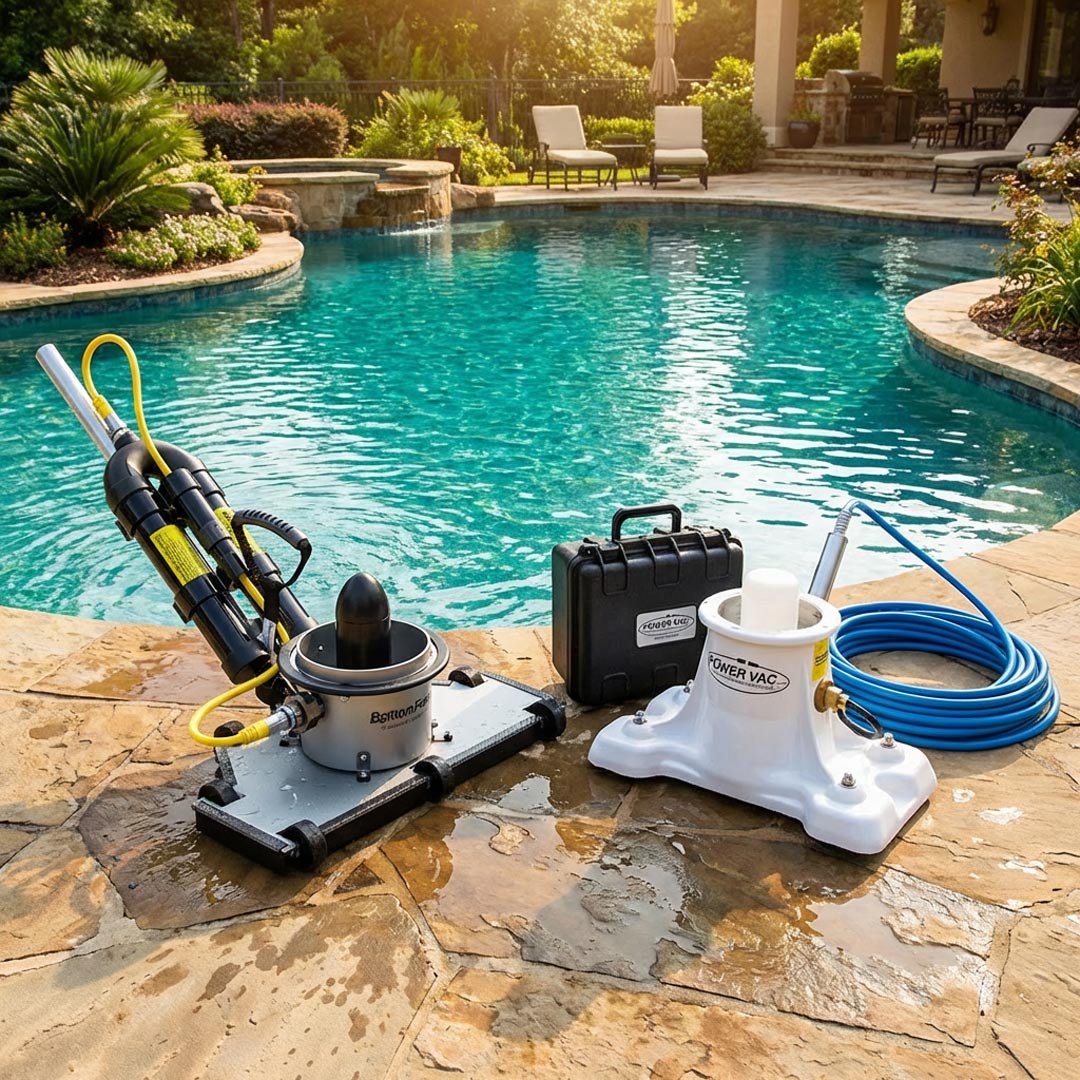
Why The Bottom Feeder Pool Vacuum Beats Power Vac in Real-World Cleaning
Keeping a pool clean fast and efficiently is essential for pool service professionals and hands-on homeowners. Both The Bottom Feeder and Power Vac are popular battery-powered pool vacuums that remove the need for traditional hoses and external pumps, but they approach portability and power very differently. When you look at day-to-day use on real service routes, The Bottom Feeder often comes out ahead for speed, simplicity, and maneuverability.
1. True Cordless Convenience vs Cord + Battery Case
The biggest difference between these two professional pool vacuums is how they deliver power.
- The Bottom Feeder houses its rechargeable LiFePO₄ battery directly on the vacuum head, so there is no separate cord running from a battery box and no extra case to carry or park beside the pool. You can walk from your truck to the water with a single, self-contained unit and start vacuuming in seconds.
- Power Vac PV-series models, such as the PV3600, use a long power cord connected to an external battery case that holds a 12V battery. While still portable, you are always tethered to that case once you’re in the pool, which adds one more bulky component and an extra step before cleaning.
For pros who want cordless pool cleaning with minimal clutter, The Bottom Feeder’s all-in-one design offers genuine untethered freedom and fewer failure points.
Advantage: The Bottom Feeder – truly cordless, no external battery case or trailing cord.
2. Lightweight, One-Trip Carrying Between Jobs
Real-world pool route efficiency often comes down to how quickly you can move from the truck to the water.
- The Bottom Feeder weighs around 18 lbs total for the head and battery pack, making it one of the lightest commercial-duty pool vac systems available, and many techs carry it in one hand along with their pole. Everything you need to vacuum is built into a compact, portable pool vacuum that feels closer to a standard manual head than a traditional cart system.
- Power Vac PV3600, for example, uses a 1/2 HP motor and a 20-inch cleaning path, and the vacuum head itself weighs about 13 lbs including cord and bag, but you also have a separate battery case weighing around 12 lbs to carry and stage by the pool. That’s two pieces of gear to manage instead of one, plus a 40-foot cord to keep organized.
If you’re doing multiple stops per day, one-trip, lightweight pool vacuum gear is a big deal in terms of fatigue and speed.
Advantage: The Bottom Feeder – lighter, one-piece carry for route-heavy days.
3. Faster Setup, Less Downtime on Every Pool
When you’re cleaning 10, 15, or more pools in a day, those small setup tasks add up fast.
- With The Bottom Feeder, you simply plug in the battery pack at poolside, clip the vac to your pole, and you’re working almost immediately, with no hoses to prime, no cords to untangle, and no cart to position. Many service pros highlight that this plug-and-play pool vac can be ready in under a minute.
- With Power Vac, you still avoid suction hoses and external pumps, which is a step up from old-school manual vacuuming, but you must position the battery case, connect the power cord, and ensure the cable lays safely as you move around the pool. This is quick compared to cart-based systems, but slower than a single cordless head.
Over a full workday, saving even a couple of minutes on each stop means more pools cleaned or a shorter day on the route.
Advantage: The Bottom Feeder – cleaner setup, faster start times, and less cord management.
4. Better Maneuverability in Tight or Awkward Spaces
Not every pool is a wide-open space with perfect access. Many backyards have narrow side paths, tight gates, planters, and obstacles.
- Because The Bottom Feeder is a one-piece cordless pool vac when built out, you’re free to move anywhere around the pool edge without dragging a cord or repositioning a battery box. This makes it ideal for tight-access pools, small yards, and properties where you park further from the water.
- Power Vac units are still more mobile than cart-and-hose systems, but the 40-foot cord between vacuum and battery case can snag on corners, furniture, or landscaping as you move, and your positioning is always limited by where the battery case sits on deck
If your route includes older homes, compact yards, or lots of side-gate access, cord-free maneuverability makes vacuuming smoother and less frustrating.
Advantage: The Bottom Feeder – superior handling and flexibility in constrained spaces.
5. Cleaning Power vs Practical Everyday Use
Both The Bottom Feeder and Power Vac are high-performance pool vacuums, but they shine in slightly different scenarios.
- Power Vac models such as the PV3600 use a powerful 1/2 HP motor with a 20-inch vacuum head and can move around 16,000 GPH, making them excellent for heavy debris like leaves, dirt, rocks, and coins, especially in large residential or commercial pools. With a 12V battery, they can run up to about 3 hours, though you remain tethered via a 40-foot cord.
- The Bottom Feeder uses a high-torque onboard motor matched to a compact frame and fine-micron debris bags, giving strong suction for typical residential debris leaves, twigs, sand, and fine particles without needing any hoses or carts. Its LiFePO₄ battery is designed for roughly 1.5 hours of runtime, which is enough to handle multiple standard pools in a typical service day.
If your work regularly involves storm cleanups, big commercial pools, or very heavy leaf loads, Power Vac’s larger motor and wide path are compelling advantages. But for routine pool maintenance, weekly cleanings, and lighter-to-moderate debris, The Bottom Feeder delivers more practical speed and simplicity with less gear to haul.
Advantage: Power Vac for extreme heavy debris; The Bottom Feeder for everyday residential and light commercial work.
6. Real-World Workflow: Which System Fits Your Pool Route?
When you factor in battery runtime, gear weight, and setup steps, the true difference is how each system fits into a typical pool route.
- The Bottom Feeder is tailored for techs who service many standard residential pools and want minimal equipment overhead no carts, no external pumps, just a compact head, pole, and net. It’s especially useful as a go-to vacuum you always keep in the truck, ready for any stop.
- Power Vac aligns more with routes that include heavier debris accounts or larger bodies of water, where the extra suction and wide cleaning path offset the added complexity of cords and a battery case.
For many pros and homeowners, the most common scenario is a normal debris load, time pressure, and tight spaces exactly where a cordless, lightweight, professional pool vacuum like The Bottom Feeder shines.
F.A.Q.
Q1: Is The Bottom Feeder powerful enough for professional pool routes?
Yes. Its high-torque motor and fine-micron debris bags are designed specifically for professional service routes and routine residential pools, not just occasional homeowner use.
Q2: How long does the battery on The Bottom Feeder last per charge?
The LiFePO₄ battery typically provides around 1.5 hours of cleaning time per charge, which is enough to service multiple standard pools in a day.
Q3: Can The Bottom Feeder handle heavy debris like large leaves and small stones?
It handles leaves, twigs, sand, and most common residential debris very effectively, but for consistently heavy loads or lots of rocks, a larger motor system like Power Vac may be better suited.
Q4: What’s the main advantage of The Bottom Feeder over Power Vac for everyday use?
For most routes it offers faster setup, true cordless operation, and easier transport, which translates into more pools cleaned per day with less physical effort.
Q5: Does The Bottom Feeder require any special cart, rack, or external pump?
No. It is a fully self-contained cordless pool vacuum; you only need your pole and standard pool tools, so storage in your vehicle is simple and compact.
Q6: Is Power Vac still a good option for some scenarios? Yes. Power Vac shines in large commercial pools or very heavy debris situations where its 1/2 HP motor and wide cleaning path can be fully utilized, even though it involves a cord and battery case.
Summary: Why The Bottom Feeder Has the Edge
Here’s where The Bottom Feeder pool vacuum stands out compared with Power Vac in real-world pool cleaning:
- True cordless vacuuming – no long power cord tethered to a battery case.
- Faster setup and teardown, saving valuable minutes on every pool job.
- Lightweight, one-trip portability that reduces fatigue on busy routes.
- Better maneuverability around tight access points, narrow gates, and cluttered decks.
- Optimized for residential and moderate-debris pools without extra components or complex rigging.
For most pool professionals and homeowners prioritizing speed, simplicity, and portability, The Bottom Feeder delivers a clear advantage in daily service and real-world performance while still offering the power needed for routine cleaning.
Share:
Why The Bottom Feeder Pool Vacuum Beats The VacDaddy Outright
The Bottom Feeder vs. Hammer-Head: Why The Bottom Feeder Wins the Race